From Branch to Mat: How Drying Decides a Zanzibar Clove’s Grade
Published 26 September 2026 · Commodities.tz Editorial
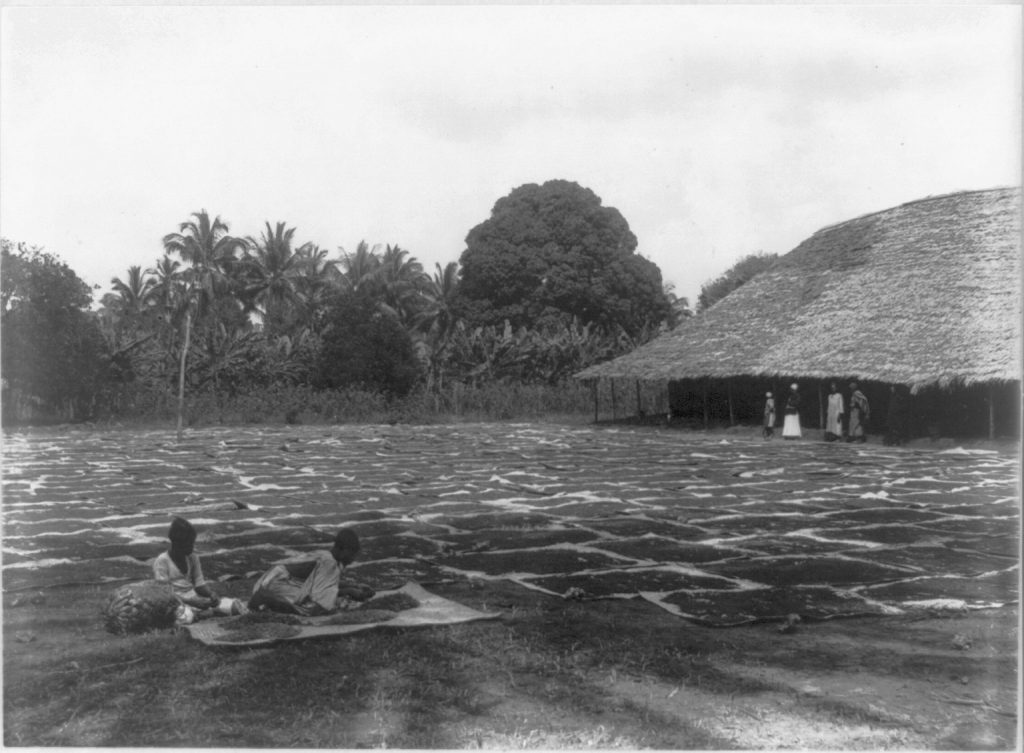
A clove is not the fruit of the tree — it’s the unopened flower bud, picked before it blooms and then dried until it hardens into the dark, oil-rich spice recognizable in any kitchen. On Zanzibar and Pemba, that drying step happens almost entirely in the open air, on woven mats laid along roads and in yards, for three to five days of direct sun. It’s a low-technology process, and it is also the single stage most responsible for determining which price grade a farmer’s harvest ultimately receives.
What drying is actually doing, chemically
Fresh clove buds carry moisture well above export-usable levels. Research on clove oil composition — including a controlled study of Zanzibar-origin clove buds specifically, published via PMC, comparing young trees (3–4 years old) against mature trees (45 years old) — used oven drying at 50°C down to a target moisture content of 13±1% as its experimental benchmark, broadly in line with the moisture ranges the wider clove trade treats as workable. Commercial grading standards documented in the industry generally place the very best hand-picked cloves below 10% moisture, a first grade below 11%, and lower grades allowed up to 13%, with anything wetter prone to mold and rejected outright or bought at the bottom of the price scale.
The same Zanzibar-focused study found that oil yield from the dried buds actually ran slightly higher in young trees (16.73%) than in mature ones (14.93%), with eugenol content — the compound responsible for both clove’s characteristic scent and most of its antiseptic and flavoring value — ranging from 68.05% to 82.38% depending on the tree’s flowering stage, peaking at full flowering in mature trees. That eugenol range sits within, though toward the lower end of, the 70–90% window generally cited for well-processed clove bud oil.
What actually distinguishes a Zanzibar clove
A separate peer-reviewed comparison — analyzing 121 commercial clove oil samples from Indonesia, Madagascar, and Zanzibar via gas chromatography, published in a study on bud, leaf, and stem essential oil composition — found real, measurable differences by origin, though notably only in stem oil, since the study’s Zanzibar samples (15 of them) were all stem-derived. Zanzibar stem oil averaged 88.46% eugenol, sitting between Madagascar’s stem oil (93.91% eugenol, the highest of the three origins) and Indonesia’s (89.02%), while carrying more β-caryophyllene (8.27% on average) than either — the compound responsible for clove oil’s woodier, less purely “medicinal” character. It’s a small but genuine chemical fingerprint: Zanzibar-origin oil isn’t simply a lower-eugenol version of Madagascar’s, it has a distinct secondary-compound profile.
Where the money is actually decided
None of this chemistry matters to a farmer unless it translates into price, and in Zanzibar it does, directly. The Zanzibar State Trading Corporation (ZSTC), the state buyer that has handled clove purchasing since 1966, sets grade-based prices at its official buying stations. As of an August 2023 revision reported by The Citizen, those prices ran 15,000 shillings per kilogram for Grade One, 13,500 for Grade Two, 12,500 for Grade Three, and 7,000 for the lowest grade — a spread of more than double between best and worst. Because grade is assessed largely on moisture, color, and the proportion of broken or “headless” buds in a batch, the three-to-five-day drying window a farmer manages at home is where that grade gets decided, well before the crop ever reaches a ZSTC scale. A batch caught by rain, dried unevenly, or pulled off the mat too early carries that damage all the way to the buying station — and the price difference between grades is large enough that the drying step is, in practical terms, worth more to a Pemba household than almost anything that happens on the tree itself.
- Alfikri et al., "Yield, Quality, and Antioxidant Activity of Clove (Syzygium aromaticum L.) Bud Oil at the Different Phenological Stages in Young and Mature Trees," PMC7290900 (2020) — https://www.ncbi.nlm.nih.gov/pmc/articles/PMC7290900/ — 2026-09-26
- Razafimamonjison, Jahiel, Duclos, Ramanoelina, Fawbush, Danthu, "Bud, leaf and stem essential oil composition of clove (Syzygium aromaticum L.) from Indonesia, Madagascar and Zanzibar," CIRAD — https://afs4food.cirad.fr/content/download/4416/33602/version1/file/Razafimamonjison,+essential+oil+of+clove+from+Indonesia,+Madagascar+and+Zanzibar.pdf — 2026-09-26
- The Citizen, "Smiles as cloves prices increase despite drop in production" — https://www.thecitizen.co.tz/tanzania/zanzibar/smiles-as-cloves-prices-increase-despite-drop-in-production-4324978 — 2026-09-26
- Global Food Network, "Understanding Clove Grades, Quality Standards & Bulk Export Requirements" — https://globalfoodnetworks.com/2026/02/04/understanding-clove-grades-quality-standards-bulk-export-requirements/ — 2026-09-26